Happy Hour #94: BLACK MIST
This is Happy Hour #94: BLACK MIST
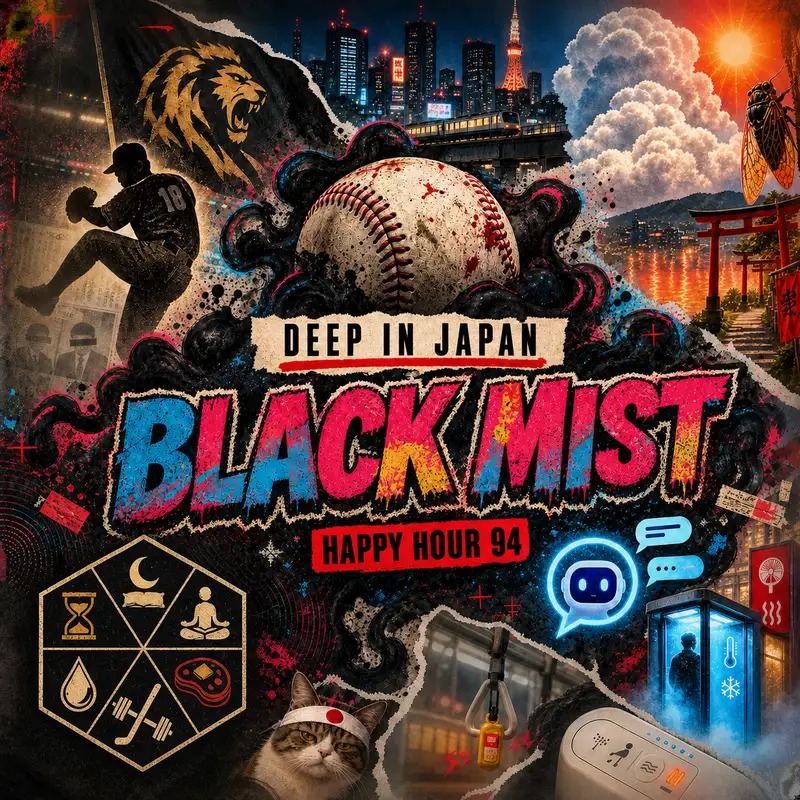
The episode opens with Jeff accusing Trevor/Trey of being twelve minutes late, Trevor insisting it was two, and both immediately blaming suspicious waveforms and future audio problems on the other (American punctuality, sanding-induced camera refusal, and early concern about 音質); Jeff congratulates Trey on intermittently reaching ketosis, then reframes keto failure as experimentation rather than shame—recover from a bad meal, identify the breaking point, and resume immediately (graceful failure beats the “fuck it” spiral); Trey recounts a prolonged crash-out involving weight regain, a stubborn plateau, heart-health concerns, quitting hockey, social isolation, and the difficulty of losing weight while training, while Jeff argues that metabolic adaptation may take months and reports that six months of keto helped him lose roughly twelve kilograms, regain pull-ups, carry kettlebells, dead-hang for two minutes, and buy a weighted vest (Piccolo’s weighted cape and boots remain the superior training system); they audit Trey’s meals—four eggs, sausage patties, Costco rotisserie chicken, ground turkey, broccoli, green beans, salsa water, almonds, and macadamias—while Jeff treats eggs as a religion, distrusts every processed ingredient, and proposes increasingly terrible podcast names including Two Guys Zero Carbs, Keto Bros, Steak and Eggs, Deep in Ketosis, and Ketone Maxing (white rice becomes “white weiss,” “two or three” becomes “two tree,” and every meal earns claps); Trey’s real obstacles are sugary caffeine, late-night cravings, inconsistent hydration, and the ten percent of extra bullshit that destroys an otherwise keto-compatible day, but a sleep study reveals apnea and a new CPAP lets him sleep eleven and a half hours, feel awake, work productively, accept the podcast invitation, and publish three articles in three days (the apparent God Mode was sleep, not ketones); this produces the episode’s central philosophy, the Keto Shield: sleep, meditation, fasting, hydration, keto, and exercise arranged as six mutually reinforcing points inside a hexagonal shield (Jeff imagines intersecting divine triangles; Trey insists that hexagons are the bestagons), with sleep as the foundation because poor sleep disrupts hunger, judgment, mood, and every other habit; Trey scores himself 12/30—sleep 4, exercise 5, keto 1, hydration 2, meditation 0, fasting 0—while Jeff lands near 22/30 and challenges him to reach 20 by the next episode (points measure consistency, not mystical meditation quality); they argue that keto makes fasting easier, distinguish strategic social carb meals from total cheat days, joke about Ozempic “stolen valor,” and envision 30/30 as an almost unattainable state of creative, physical, and philosophical superpower; Jeff, newly fifty, says his goal is not merely looking good in a Speedo but thinking clearly, moving without pain, living long enough to play with grandchildren, and avoiding the inflammation, brain fog, intestinal trouble, irritability, and physical decline he felt before recommitting to keto (Trey still considers the Speedo aspirational); a proposed book evolves from The Deep in Japan Diet: How Two Fat Middle-Aged Podcasters Found the Secret to Six-Pack Abs Deep in Japan toward The Keto Shield, complete with an AI-generated cover and a possible steak-dinner six-pack wager; Trey then uncovers a 2014 email showing Jeff beginning keto before their friendship properly started, meaning keto evangelism predates their first mountain climb, Trevor’s lost apartment key, and nearly everything else in their relationship (Jeff says keto relieved years of debilitating allergies, though the discussion remains personal testimony rather than medical proof); good sleep leads into Trevor’s new Deep in Japan articles: Uni, the Japanese Cat presents a satirical interview with an internet-famous cat whose nationalist translator turns meows, blinks, box-sitting, and Roomba hissing into opinions about immigration, globalization, education, national confidence, and Saitama (Uni may simply be a cat); Obachan’s Going to Jail explores elderly Japanese women allegedly committing petty theft to obtain food, healthcare, companionship, work, supervision, and purpose in prison (an eight-dollar onigiri theoretically unlocks tens of thousands of dollars in state support), prompting discussion of aging, poverty, loneliness, prison incentives, paywalls, sourcing “the sauce,” and Japan’s weak yen; with the dollar around ¥163, they discuss the widening divide between people paid in dollars and yen, Jeff’s taxes, Miho’s repaired Vellfire and overlooked alignment, Japan’s gold driving licenses, elderly-driver marks, and locals’ horror when Jeff jokingly displayed one at forty; bumper stickers open a tangent on Japanese political signaling—outdoor-brand stickers, black-and-gold chrysanthemums, uyoku trucks, nationalist four-character slogans, anti-foreigner signage, yak-styled houses as burglary deterrents, and the idea of disguising Jeff’s vehicle as an intimidating right-wing machine (foreigners could theoretically be “erased,” one truck driver at a time); the next article follows a teenage girl who catches a fifty-eight-year-old taking upskirt photos and escorts him to police, leading to debate over whether she physically dragged him, whether train perverts are weak-willed “beta-cuck pajama boys,” and how girls should respond (judo grips, alarms, pointing and shouting “chikan,” direct eye contact, emergency plans, visible hands, or school-issued sasumata); Jeff then recounts witnessing a man violently assault a woman on a station platform during his early Japan years, intervening with limited Japanese—essentially “stop” and “please be gentle”—standing between them while everyone else looked away, then boarding his train only to see the attack resume as the doors closed (fear of violence, deportation, bystander paralysis, lasting regret, and the limits of imperfect intervention); the conversation moves to a ¥1.5-million “human refrigerator,” a wheeled one-person cooling booth inspired by vending machines and designed for construction sites, farms, commutes, concerts, and sports days (ideally paired with fan vests, a cooling hood, fried chicken, and two Gundam buckets of Strong Zero); Jeff mourns the end of his children’s undōkai era and learns that older sports days once had food stalls and drinking, while both imagine privately installing a refrigerator box at the field and watching everyone else roast; the joke turns serious as they discuss Japan’s increasingly dangerous heat, children and elderly people collapsing, air-conditioning in schools, and figures they pull for 2026 showing tens of thousands of ambulance transports and a majority of patients over sixty-five (the missing statistic is heat-stroke deaths among bears); Trey recalls climbing Kyoto’s Fushimi Inari area during a 41°C day in 2019 without enough water, barely reaching his hotel, collapsing in front of the air conditioner, and abandoning the rest of his Kyoto plans (heat plus humidity defeats gaman); a technology tangent covers Claude’s opaque premium-token billing and default model selection, OpenAI’s unnervingly lifelike Japanese voice “Sol,” conversational fillers so natural that it feels like a real woman reminiscing about Oregon, and the possibility that AI will first join and then entirely replace the podcast hosts; they next examine an article about a famous baseball coach whose eighteen-year-old daughter asked ChatGPT what to do after he pushed her down during a family argument, followed ChatGPT’s suggestion to contact a human support service, and was shocked when the service automatically contacted police, leading to his arrest and resignation (ChatGPT connected her to people rather than directly adjudicating the crisis); Japanese media, in their telling, focused less on the father’s behavior or the reporting service and more on AI dependency, the daughter’s regret, and the destruction of a beloved coach’s career, exposing tensions among domestic privacy, victim agency, celebrity loyalty, patriarchal norms, mandatory reporting, and fear of AI (their final position is simple: do not hit your children); a television segment blaming foreign drivers for failing to understand left-side traffic—supposedly inherited from samurai keeping swords from colliding—lets Jeff enjoy being silently judged by his father-in-law while the family’s recently damaged Vellfire sits outside (the driver keeps the center line nearest them; stop being so foreign); they attempt to finish with a Sora News list of Japanese summer words—natsu, umi, suikawari, hiyake, kīn to suru, semi, nyūdōgumo, and hanabi—but condemn it as an incoherent mix of absolute beginner vocabulary and obscure meteorology, then ask AI for a stronger set including natsuzora, aoarashi, kunpū, yūdachi, semishigure, komorebi, enten, nettaiya, and nigemizu (nyūdōgumo, “towering cumulonimbus cloud,” becomes homework Jeff must awkwardly force into conversation); Trevor promises a better Deep in Japan summer-language article while Jeff proposes abandoning English Sora News for Japanese Rocket News and remembers an epic article in which Mr. Sato walked roughly fifty thousand steps, eating treats along the way before apparently continuing to pole dancing (journalistic excellence); baseball terminology extends the episode again: yakyū means field ball, an out is a “death,” recording an out is a “stab kill,” a double play is a “combo kill,” and the leadoff batter is the “shock-troop captain” (plus detours through dead balls, uteruses, semi-double beds, sailor-uniformed nineteenth-century teams, Masaoka Shiki, and Waseda stolen valor); they discover Tadashi Wakabayashi, a Hawaii-born pitcher who played in Japan through the war and became a Hanshin Tigers MVP, then tour Japan’s corporate team names—the Yakult Swallows and umbrella dance, Nippon-Ham Fighters, SoftBank Hawks, Orix Buffaloes, DeNA BayStars, Rakuten Golden Eagles, and Seibu Lions (are they fighting ham, or are they themselves ham?); the Saitama Seibu Lions provide the final revelation: their predecessor was nearly destroyed by the 1969–71 Black Mist scandal, in which organized crime bribed players to throw games, players received lifetime bans, trust and attendance collapsed, and the franchise eventually relocated and rebranded, only to suffer a later secret-recruiting-money scandal (Saitama crime jokes unexpectedly become historical research); “Black Mist” consequently becomes a philosophy and verb—going full Black Mist, going rogue, embracing the mist, and “going Saitama on that ass”—as they revisit years of allegations that Saitama is poor, criminal, unfashionable, spiritually hollow, owned by mobsters, riddled with hell pits, and equipped with drainage tunnels designed to flush the prefecture into the sea (Tonde Saitama and its sequel prove Japan enjoys the joke too, inspiring a possible paid, legal watch-along); the exhausted ending returns to the Keto Shield, with Jeff demanding Trey rise from 12 to 20, promising a meditation book, defending his legitimately purchased digital keto book against Saitama piracy, and adding Tenga as the shield’s hidden seventh-dimensional spear (medication, hydration, meditation, masturbation); they promote the Deep in Japan blog, Etsy shirts, and Trevor’s forthcoming Toto washlet—$1,400 for eventual entry into civilization—while briefly recalling Trevor’s 音質 article, in which Jeff attains sandan in the art of audio quality through spectrograms, coffee, and unanswered Discord complaints about Trevor eating chips during intros; finally, Jeff announces that an underground hip-hop track called “Black Mist” will play them out, Trevor warns that his recording has been visibly ticking for nearly five hours, and the episode ends with steak hunger, mind-Toto purification, Black Mist philosophy, Saitama validation, and one last piece of audio for Jeff to clean up (four hours and forty-seven minutes of maniac shit).
Sauce/References:
Deep in Japan blog & articles
Man in Japan calls in bomb threat because he doesn’t want to go to his own work farewell party
Eight great words for talking about summer in Japan in Japanese
Foreign hiker on Mt. Fuji loses consciousness and dies, becoming climbing season’s second fatality
99-year-old woman rescued while attempting to climb Mt. Fuji
“Stab-kill for two deaths” and other fun Japanese baseball terms
A donut and sugar-loving bear in Japan is breaking into homes, checking fridges for sweet snacks
Japan now has human refrigerators inspired by Japanese vending machines
Mass murder plot stopped by friend of Akihabara mass murderer
Teen girl in Japan refuses to be victim, personally escorts train pervert to police for arrest
Trevor’s idea of a keto meal
Uniuni the Cat
Face lettuce appears in Japan
Japanaese jackets with electric fans
Former Giants manager’s daughter consulted ChatGPT before reporting altercation
Outro Song: "Black Mist"
Enjoying the show?
Consider supporting us. Every little bit helps keep this magnificent shitshow lurching forward. And while you’re at it, join the conversation over on Facebook, and follow us on X/Twitter at @DogePunk2077.
For inquiries, complaints, spiritual confessions, legal threats, guest pitches, or reasonably coherent messages, you may be able to reach us at deep.in.japan.podcast@gmail.com. Then again, you may not. Show supporters, naturally, jump the queue—so if you’re one of the blessed few, The Chosen, be sure to mention that at the top of your message for maximal response potential.
Thanks for listening!